In plastic straw production lines, while the products appear structurally simple, the requirements for extrusion stability are quite high. The outer diameter, wall thickness, roundness, surface finish, and length consistency of the straws after cutting are all closely related to the state of melt delivery at the front end. If the pressure at the extruder outlet fluctuates significantly or the feed to the die is unstable, problems such as uneven wall thickness, inconsistent tube diameter, surface ripples, and unstable output speed are likely to occur. In continuous production, these minor fluctuations not only affect product appearance but also increase setup time and scrap rates.
Straw production lines typically use plastics such as PP and PE as primary raw materials, which are plasticized by the extruder before entering the die for shaping. Many operators assume that as long as the extruder speed is stable, the output should be stable. However, in actual production, factors such as the plasticization state of the screw, the proportion of recycled material, temperature fluctuations, filtration resistance, and changes in die backpressure all affect melt pressure. In other words, since the extruder itself must perform plasticization while also handling material feeding and pressure buildup, pressure fluctuations are difficult to completely avoid.
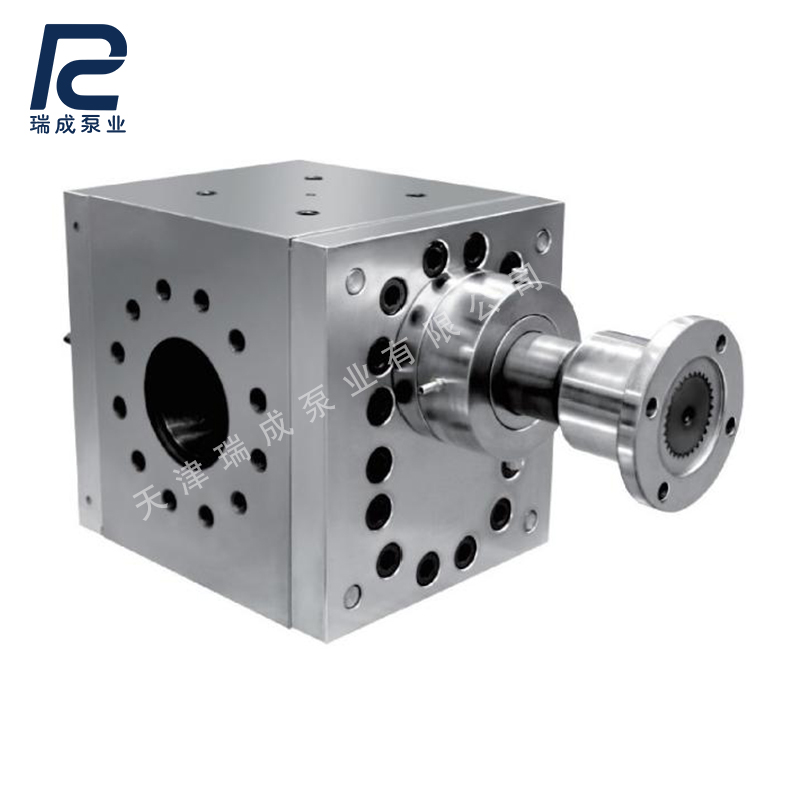
Installing a melt pump between the screw extruder and the die serves the primary purpose of “isolating” fluctuations from the front end. The melt pump creates continuous positive displacement through gear meshing, further pressurizing and stabilizing the melt output from the extruder, and delivering it to the straw die at a more consistent flow rate. As a result, the pressure at the die inlet becomes more stable, and the melt enters the die in a more uniform state. This helps address issues such as variations in straw wall thickness, fluctuations in outer diameter, and discontinuous extrusion.
For thin-walled tubular products like straws, stable material supply is particularly critical. Because straws have thin walls and small diameters, any pressure fluctuation is magnified in the final product dimensions. If the pressure at the front end is too high, the output increases, and the straws may become thicker and wider; if the pressure is too low, the output decreases, and the straws may become thinner, deform, or even affect the synchronization of traction and cutting. Installing a high-precision gear-type melt metering pump ensures a consistent relationship between melt flow rate and pump speed, making it easier to maintain stability in the downstream traction, cooling, sizing, and cutting processes.
The melt pumps manufactured by Tianjin Ruicheng Pump Industry Co., Ltd. are suitable for a wide range of production lines, including plastic extrusion, pipe, sheet, film, and pelletizing. In straw production lines, we can match a melt pump with the appropriate flow rate based on the customer’s output, raw material type, extrusion temperature, die pressure, tube diameter specifications, and continuous operation requirements. The equipment can be installed between the extruder outlet and the die to stabilize the pressure upstream of the die head and reduce the impact of extrusion fluctuations on product dimensions.
If issues such as fluctuating output rates, uneven wall thickness, unstable product surfaces, or prolonged setup times have already arisen during straw production, the cause should not be attributed solely to the die, haul-off, or cooling water tanks; attention must also be paid to whether the melt pressure from the extruder outlet to the die inlet is stable. In many cases, a single melt gear metering pump matched to the operating conditions can make the material supply status of the entire production line more controllable.
Of course, installing a melt pump is not simply a matter of “adding another piece of equipment”; rather, the selection must be made in conjunction with the entire straw production line. The pump’s displacement must not be too large or too small; the speed range must match the production output; the inlet pressure must be sufficient; and temperature control must be coordinated with the extruder and die. If the selection is inappropriate, it may instead result in insufficient inlet feed, abnormal pressure, or excessive load on the pump.
Overall, the value of adding a melt pump to a straw production line lies not only in increasing pressure but, more importantly, in stabilizing pressure and flow rate while enhancing product consistency. For companies seeking continuous production, reduced scrap rates, and improved dimensional stability of straws, Tianjin Ruicheng Pump Industry’s melt pumps provide a more stable and precise melt delivery solution for straw extrusion production.