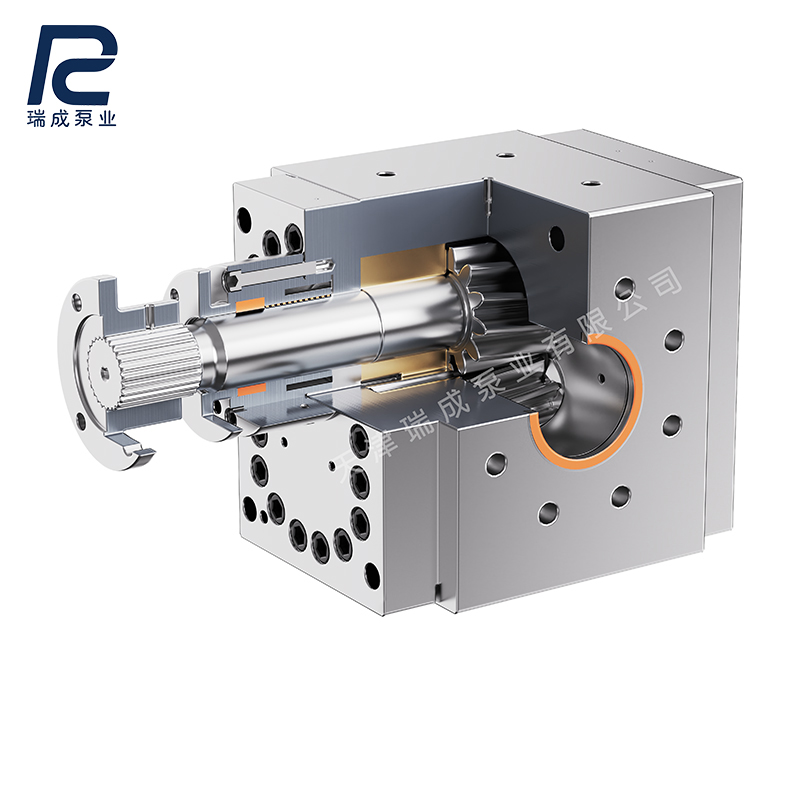
In the plastic extrusion process, the stability of melt delivery directly affects product quality and production efficiency. Whether in sheet, film, pipe, fiber, or pelletizing processes, significant fluctuations in melt pressure can lead to inconsistent product dimensions, reduced surface quality, and even disrupt the continuous operation of the entire production line. As a result, an increasing number of companies are installing dedicated melt pumps in their extruder systems to enhance overall line stability and automation levels.
Extruder-specific melt pumps, also known as melt metering pumps or melt gear pumps, are typically installed between the screw extruder and the die. Their primary function is to stabilize, boost, and precisely meter the flow of high-temperature, high-viscosity polymer melt. Industry data indicates that melt pumps are widely used in extrusion applications such as sheet, plate, pipe, film, pelletizing, filament drawing, cable, and co-extrusion.
In traditional extrusion systems, many companies rely entirely on the extruder itself to generate pressure. However, due to inherent fluctuations in screw conveying—particularly under conditions of high filler content, high viscosity, or high output—melt pressure is prone to instability. In such cases, increasing the extruder’s load not only raises energy consumption but also risks excessive material shear and overheating, thereby compromising product quality.
In contrast, melt pumps utilize a positive-displacement gear-driven design. By achieving stable conveyance through high-precision gear meshing, they effectively mitigate extrusion fluctuations, resulting in a more uniform melt flow entering the die. Relevant data indicates that melt pumps generally outperform extruders when it comes to stabilizing melt pressure and flow rate.
For industries with high requirements for thickness uniformity, such as sheet and cast film production, stabilizing melt pressure significantly reduces lateral thickness variations and results in a smoother product surface. In the pipe and cable industries, more stable melt output helps improve outer diameter consistency and surface finish. In pelletizing lines, stable melt delivery also reduces fluctuations in pellet size and enhances pelletizing stability.
In addition to pressure stabilization, melt pumps offer the advantages of increased output and reduced energy consumption. Since pressure is primarily generated by the melt pump, the extruder’s own workload is reduced, thereby alleviating stress on the screw and gearbox and extending equipment lifespan. For some production lines, the installation of a melt pump not only stabilizes product quality but also boosts overall production capacity while maintaining lower energy consumption.
Currently, extruder-specific melt pumps are compatible with a wide range of polymer materials, including thermoplastics such as PE, PP, PET, ABS, PA, TPU, and EVA, as well as certain rubber and elastomer applications. To accommodate varying material properties, these pumps can be configured with wear-resistant designs, electric heating systems, thermal fluid heating systems, and specialized sealing methods to meet diverse production requirements.
As a company specializing in the manufacture of melt conveying equipment, Tianjin Ruicheng Pump Industry Co., Ltd. has long provided melt pump solutions for the plastic extrusion, sheet and film, rubber and elastomer, and chemical fiber industries. The company can tailor solutions to meet specific customer process requirements regarding flow rate, pressure, temperature, material viscosity, and installation configuration, helping enterprises improve extrusion stability and product consistency.
Against the backdrop of the plastic processing industry’s ongoing shift toward higher precision and efficiency, melt pumps have evolved beyond simple pressure-boosting devices to become a critical component in enhancing production line stability. For extrusion lines with stringent quality requirements, the proper configuration of extruder-specific melt pumps not only improves product quality but also delivers more stable and efficient production outcomes for enterprises.