In plastic extrusion production, the screw must not only convey, melt, and mix the material but also overcome the resistance generated by the screen changer, connecting runners, and the die. As production speeds increase, or when changes occur in the raw material formulation or melt viscosity, relying solely on the screw to build pressure can easily lead to fluctuations in pressure and flow rate at the outlet. For film, sheet, plate, pipe, profile, and pelletizing production lines, such fluctuations often manifest in product thickness, dimensions, and discharge conditions.
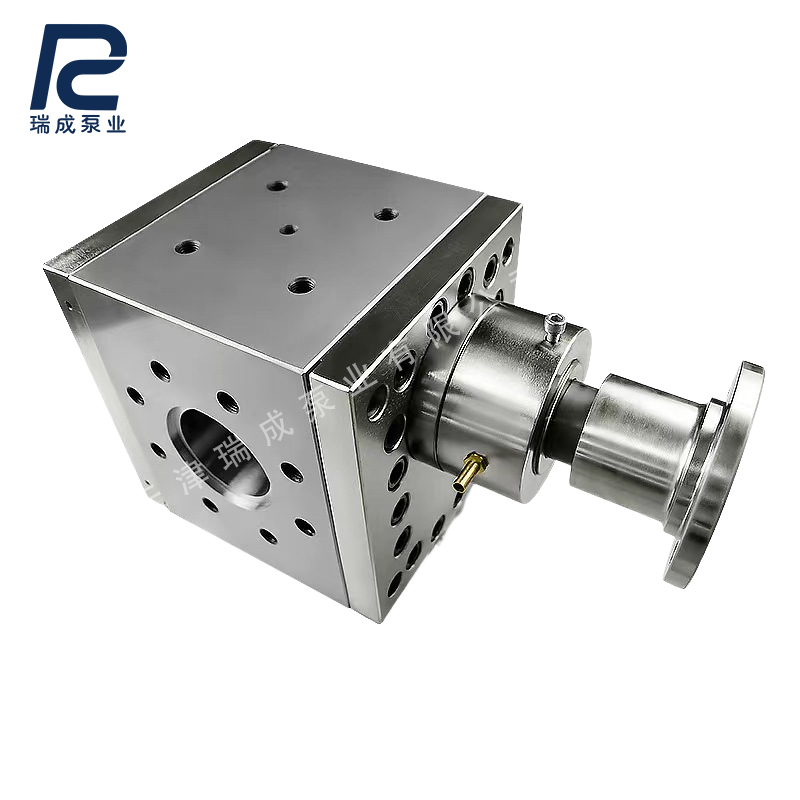
Melt pumps are typically installed between the extruder and the die, though they can also be installed before or after the screen changer depending on the equipment configuration. Internally, they consist of a pair of meshing gears. As the gears rotate, the melt enters the gear teeth from the inlet and is conveyed along the inner wall of the pump body to the outlet, creating relatively stable pressure and flow at the outlet side.
Sharing the Screw’s Pressure-Building Task
When the extruder outlet pressure is high, the pressure on the screw also increases. Installing a melt pump allows the pump to assume part of the pressure-building task, freeing the screw to focus more on plasticization and mixing. This enables the production line to operate in a relatively stable state and facilitates adjustments to screw speed and process temperature.
Reducing Fluctuations in Outlet Pressure and Flow Rate
Screw delivery rate is influenced by rotational speed, temperature, raw material form, the proportion of recycled material, and feeding conditions. Since melt pumps are positive-displacement devices, their discharge volume has a clear correlation with gear speed within a reasonable range of rotational speeds and pressure differentials. By adjusting the pump speed, the melt flow rate entering the die can be controlled, thereby minimizing the impact of upstream operating conditions on subsequent molding processes.
Improving Product Consistency
The production of films, sheets, and plates has strict requirements for thickness uniformity, while the production of pipes and profiles requires attention to outer diameter, wall thickness, and dimensional stability. Fluctuations in the melt flow rate entering the die result in corresponding changes in the product’s condition. The melt pump can buffer some of the pressure fluctuations at the extruder outlet, ensuring a more stable feed to the die and providing relatively stable conditions for subsequent drawing, cooling, and shaping.
Supporting Screen Changes and Continuous Production
As impurities gradually accumulate on the filter screen, the pressure differential across the screen changer varies. A melt pump, in conjunction with a pressure sensor and control system, can adjust its speed to minimize the impact of changes in filtration resistance on die feed. However, a melt pump cannot replace the filtration system, nor can it resolve issues such as insufficient material plastification or severe screen clogging; the entire production line still requires maintenance based on actual pressure changes.
A larger displacement does not necessarily make a melt pump more suitable. When selecting a model, a comprehensive calculation must be performed based on factors such as raw material viscosity, filler content, melt temperature, hourly output, inlet pressure, outlet pressure, allowable pressure differential, and installation space. The pump body material, gear structure, bearing type, sealing method, and heating solution should also be matched to the specific material and operating conditions.
Tianjin Ruicheng Pump Industry Co., Ltd. can provide melt pumps along with matching drive, reduction, and control solutions based on extrusion equipment parameters, material characteristics, and production requirements. Through proper selection and process integration, the melt pumps can more effectively contribute to melt conveyance, pressurization, and metering.