Tianjin Ruicheng Pump Industry Co., Ltd. has encountered similar cases in its practical service experience. A customer in the recycled plastic pelletizing industry reported that, after the production line had been running for some time, pellet output gradually declined. The initial assessment was that the melt pump’s flow rate was insufficient. After analyzing the on-site conditions, Ruicheng Pump Industry’s technical staff discovered that the recycled material used by the customer contained a high level of impurities, causing frequent clogging of the filtration system. This resulted in an unstable feed at the pump inlet. At the same time, prolonged operation under high loads had caused the internal clearance of the pump to increase. After cleaning the filtration system, optimizing temperature control, and performing maintenance on the melt pump, the stability of the production line’s output improved significantly. This case illustrates that a decline in melt pump flow rate is rarely caused by the pump alone, but rather results from the combined effects of material properties, process conditions, filtration, and equipment wear.
So, if you also encounter a situation where the flow rate of your melt pump is gradually decreasing, how should you conduct a self-inspection?
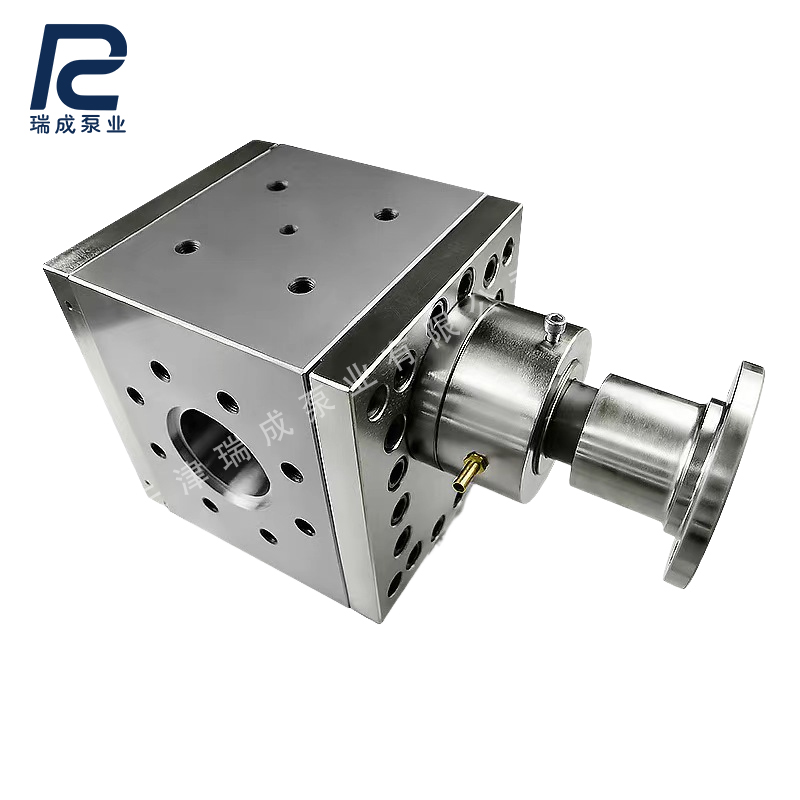
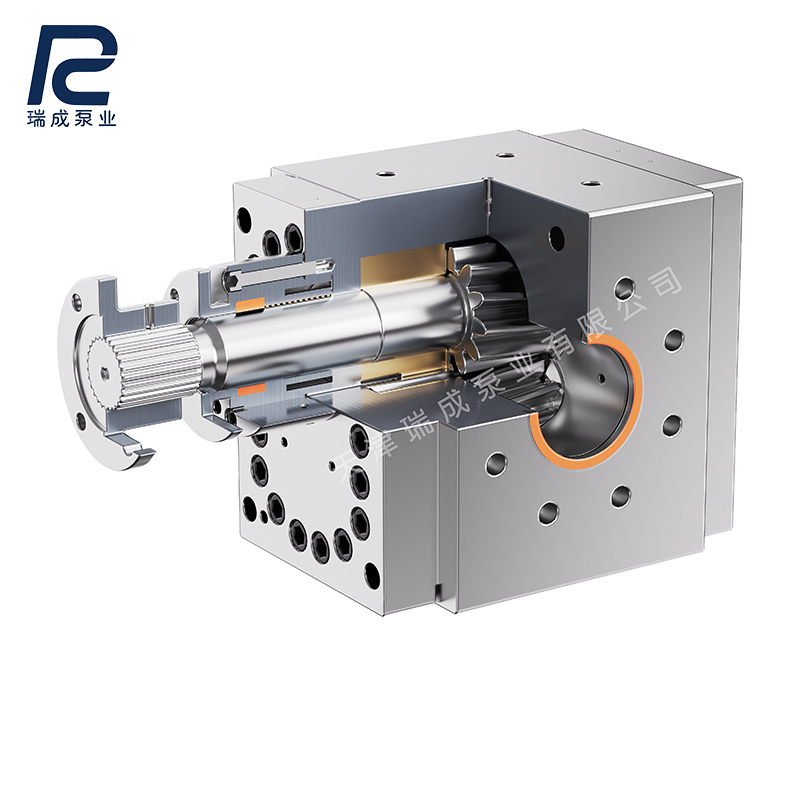
First, focus on inspecting internal wear within the pump housing. Melt pumps are positive-displacement gear pumps that rely on gear meshing to achieve continuous delivery. After prolonged operation in high-temperature, high-pressure, and high-viscosity materials, the gear end faces, shaft sleeves, bearings, and inner walls of the pump chamber are subjected to significant friction. If the material contains fillers, impurities, recycled material particles, or abrasive components, wear will accelerate further. Once internal clearance increases, melt backflow occurs within the pump chamber, reducing actual output. Even if the rotational speed remains constant, the discharge flow rate will gradually decrease.
Second, insufficient feed at the inlet is also a common cause. The melt pump itself does not generate material; it relies on a continuous and stable supply from the upstream extruder. If the extruder lacks sufficient plasticizing capacity, feeding is uneven, the filter screen is clogged, or inlet pressure is too low, the pump inlet will not be fully filled with material, resulting in insufficient suction. In this case, although the pump is running, the actual amount of material conveyed per revolution decreases, manifesting as reduced flow rate, pressure fluctuations, or even intermittent discharge.
Third, changes in material temperature and viscosity also affect flow rate. At low temperatures, material viscosity increases, flow resistance rises, the pump’s load increases, and conveying efficiency decreases; at excessively high temperatures, some material may degrade or carbonize, producing hard particles or coke deposits, which not only affect product quality but may also accelerate wear on gears, bushings, and the pump chamber. Therefore, special attention should be paid to temperature control stability when processing PET, PA, TPU, hot melt adhesives, and recycled materials.
Fourth, increased system resistance is often mistakenly interpreted as a “decrease in pump flow rate.” For example, screen changer blockages, increased die resistance, material buildup in pipes, and excessively high filtration precision can all cause outlet pressure to rise. When system backpressure exceeds a reasonable range, internal leakage in the pump increases, and the actual flow rate reaching the die decreases. Therefore, when assessing a decline in melt pump flow rate, one must not only inspect the pump itself but also conduct a comprehensive analysis that considers inlet pressure, outlet pressure, the filtration system, die condition, and motor current.
Consequently, if a melt pump’s flow rate decreases over time, it is not recommended to blindly increase the speed or immediately replace the equipment. One should first verify whether there have been changes in the material, temperature, pressure, or upstream feeding, and then inspect the pump body for wear, shaft sleeve clearance, gear end faces, and seal condition. For equipment in long-term operation, a regular maintenance schedule should be established to prevent minor wear from escalating into major failures.
Overall, a decrease in melt pump flow rate is typically associated with internal wear, insufficient material supply, abnormal temperatures, increased system resistance, and impurities in the material. Through proper pump selection, stable temperature control, enhanced filtration, and avoidance of dry running and overpressure operation, the service life of the melt pump can be effectively extended, ensuring continuous and stable operation of the extrusion production line. Tianjin Ruicheng Pump Industry can provide melt pump selection, maintenance, and application recommendations based on customers’ material characteristics, production requirements, pressure ranges, and on-site operating conditions, helping customers improve production stability.