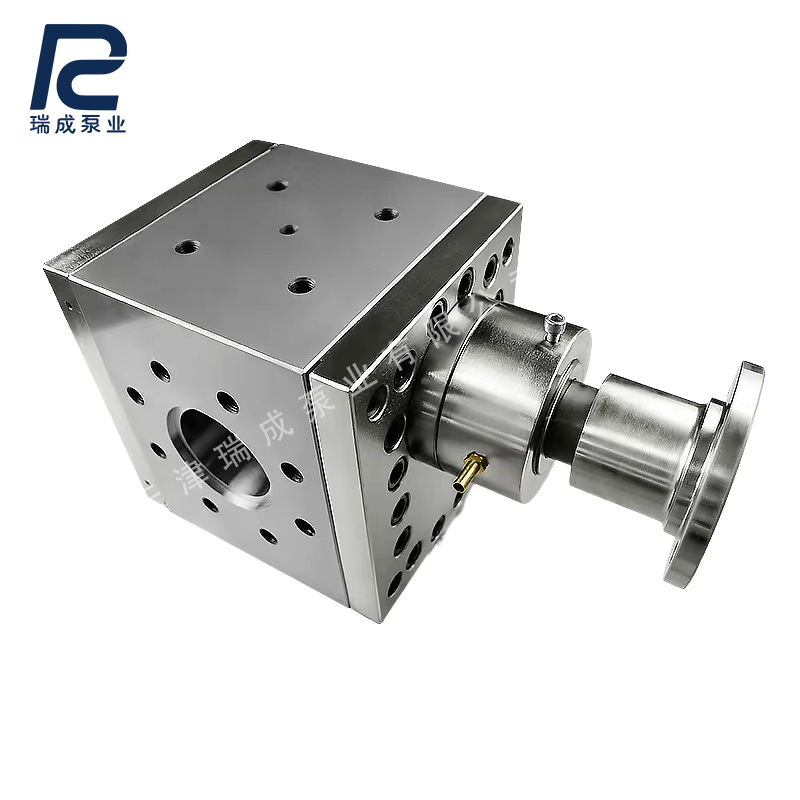
In the extrusion processing industries—such as plastics, synthetic fibers, and petroleum—reducing production costs while increasing output remains an enduring goal for companies. As a key auxiliary machine in extrusion production lines, the melt gear pump serves as an effective tool for achieving this objective. Installed between the extruder and the die, it separates the pressure-building function from the screw, resulting in significant energy savings and increased production.
In traditional extruders, the screw is responsible for both melting the material and overcoming die resistance to build pressure; this “one-man-show” approach has limited efficiency. With the installation of a melt pump, the screw focuses on melting and mixing, while the melt pump is dedicated to pressure buildup and delivery. Since the backpressure at the extruder outlet is significantly reduced, backflow and leakage within the screw barrel are markedly minimized—at the same screw speed, output can increase by 20%–30%. Additionally, as a positive displacement pump, the melt pump’s output flow rate is strictly linear with gear speed, eliminating pressure fluctuations and enabling the production line to operate stably at high speeds, further increasing the yield of conforming products.
Energy savings are equally significant, with energy consumption per kilogram of processed material reduced by approximately 25%. First, the extruder no longer needs to overcome substantial die resistance, resulting in lower screw torque and reduced current load on the main motor, which directly saves electricity. Second, in traditional high-pressure extrusion, the melt generates a large amount of unnecessary heat due to intense shear forces, often requiring forced cooling; after installing a melt pump, the system operates at low pressure and low temperature, significantly reducing shear heat, thereby saving both heating and cooling energy. Furthermore, due to improved operating conditions, wear on the screw and barrel is significantly reduced, extending equipment service life and lowering maintenance and replacement costs—which in itself constitutes an indirect energy saving.
Melt gear pumps can also control outlet pressure fluctuations within ±1%, significantly improving product dimensional accuracy and reducing scrap rates. This means that every kilowatt-hour of electricity and every kilogram of raw material is converted into qualified products, achieving comprehensive cost reduction and efficiency gains.
Tianjin Ruicheng Pump Industry Co., Ltd. is committed to providing high-performance melt gear pump products, helping customers gain cost advantages through technological upgrades.