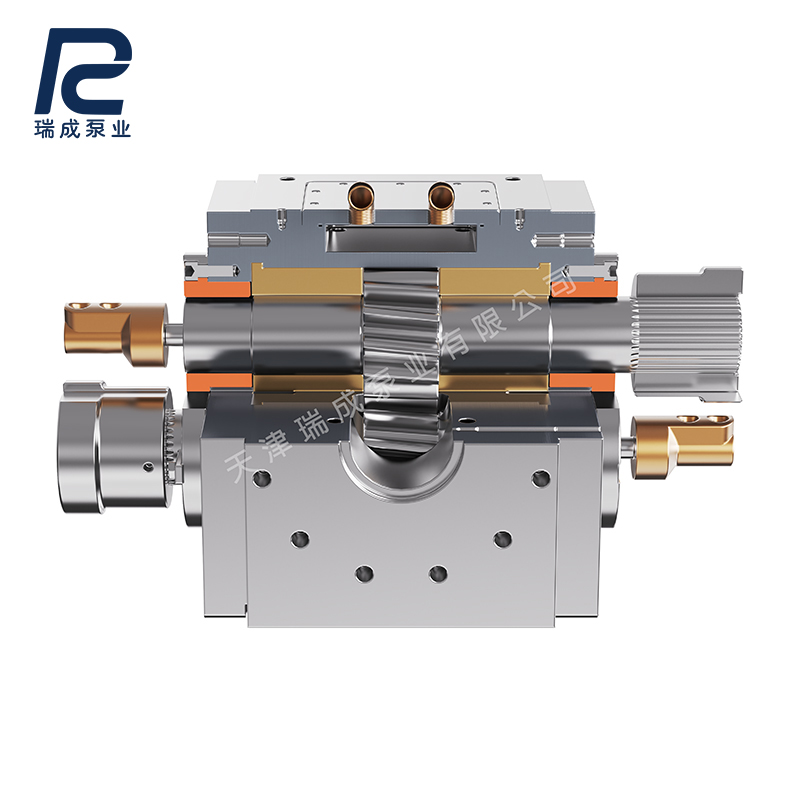
During the extrusion process, rubber and elastomer materials typically exhibit characteristics such as high viscosity, high flow resistance, and sensitivity to shear. When changes occur in screw speed, feed conditions, temperature, or die resistance, die pressure and output volume may also fluctuate. A rubber melt pump is installed between the extruder and the die head. It utilizes gear meshing to create a relatively stable delivery volume, providing a continuous feed for subsequent processes such as extrusion, calendering, and molding.
I. Adaptation to High-Pressure Conditions
Rubber materials have low flowability, resulting in significant pressure losses as they pass through filtration devices, flow channels, or die heads. The pump body, gears, bearings, and sealing structure of a rubber melt pump must be designed based on actual inlet pressure, outlet pressure, and pressure differential to withstand the mechanical loads encountered during production.
Once the pump is operational, it can share the burden of building pressure with the extruder, allowing the screw to focus more on plasticizing, mixing, and conveying functions. Proper configuration of the melt pump helps reduce die pressure fluctuations and improves the extruder’s operating performance under high backpressure conditions.
II. Conveying High-Viscosity Materials
Materials such as rubber, silicone rubber, and thermoplastic elastomers have high viscosity, and standard conveying equipment is prone to issues such as insufficient feed, internal leakage, or excessive rotational resistance. Rubber melt pumps typically employ a positive displacement conveying principle: once the material enters the gear pockets, it is conveyed along the pump chamber to the outlet as the gears rotate.
For different materials, the pump’s flow passages, gear profile, internal clearances, and surface treatment can be adjusted. Smoother internal flow channels reduce material retention, while proper gear clearance helps balance conveying capacity and operating resistance. For heat-sensitive rubber, it is also necessary to control pump speed, temperature, and residence time to minimize the effects of localized shear-induced heating.
III. Improving Metering Stability
The instantaneous output of a screw extruder may be affected by variations in raw materials, rotational speed, and pressure, whereas a melt pump delivers a relatively fixed theoretical displacement per revolution. By adjusting the pump’s rotational speed, material output can be controlled to ensure that the feeding rhythm matches the die’s requirements.
Stable flow rate and pressure help minimize dimensional fluctuations in rubber strips, sheets, sealing strips, and rubber tubing, and also facilitate coordination of haul-off speed, die pressure, and output per unit time on the production line. It should be noted that actual metering performance is also affected by material viscosity, temperature, pressure differential, and internal leakage; therefore, displacement alone should not be the sole criterion for selection.
IV. Common Structural Configurations
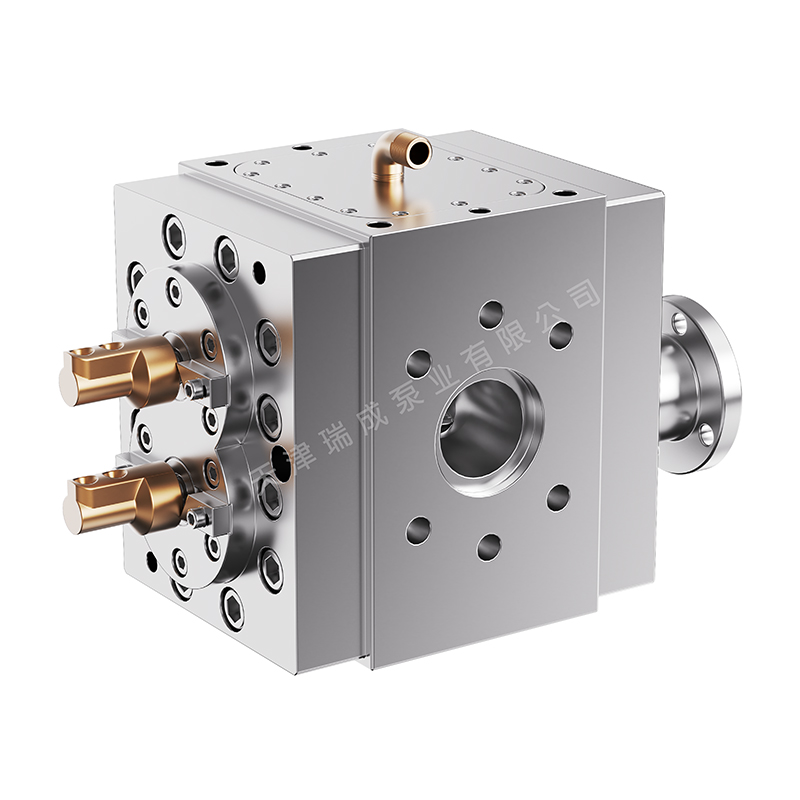
Depending on material characteristics and operating loads, rubber melt pumps can employ either a single-drive or dual-drive configuration. A dual-drive configuration features two separate drive units each driving a set of gears, which helps distribute the load on the shaft ends and is suitable for applications with higher pressure and greater viscosity. The single-drive configuration is relatively compact and can be configured according to production line space and process conditions.
Seal types, bearing materials, heating methods, and drive power must also be determined based on material temperature, corrosiveness, lubricity, and continuous operating time; simply applying generic parameters should be avoided.
The value of rubber melt pumps lies not only in material conveyance but also in maintaining stable pressure, flow, and metered feed rates. Tianjin Ruicheng Pump Industry can perform operating condition analyses based on material name, viscosity, temperature, inlet pressure, outlet pressure, flow rate, and installation method, providing selection guidance for the construction, retrofitting, and equipment configuration of rubber extrusion production lines.