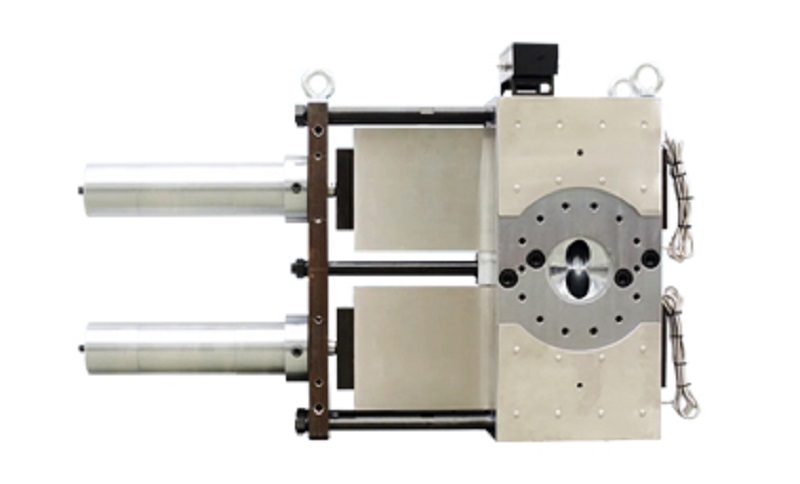
In the hot-melt adhesive pelletizing process, resins, tackifiers, waxes, fillers, and other additives are heated and mixed to form a fluid melt, which is then processed through extrusion, filtration, cooling, and pelletizing to produce pellets. Due to factors such as raw material purity, heating time, and residual material inside the equipment, the molten melt may contain unmelted particles, gels, carbonized matter, or fine impurities. If these substances enter the extrusion die directly, they may cause channel blockages, uneven output, string breaks, or fluctuations in pellet appearance. The double-plate screen changer is installed between the extruder and the die and is primarily responsible for filtering the melt.
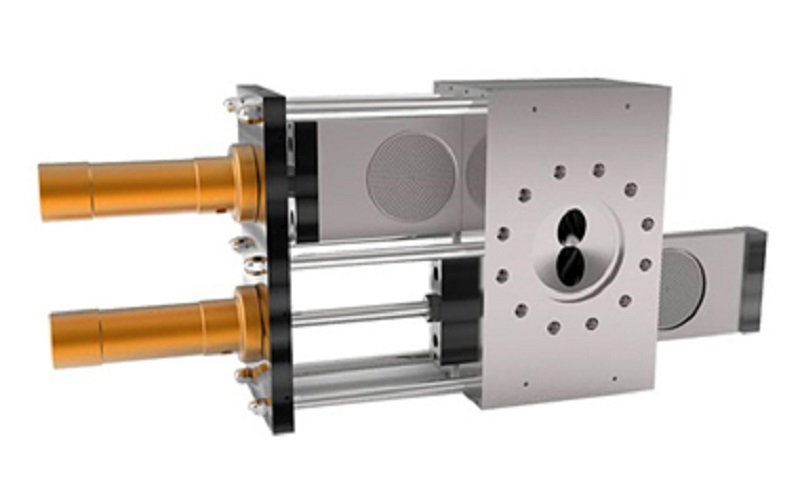
I. Basic Structure of the Double-Plate Screen Changer
A double-plate screen changer typically consists of a main body, two sliding plates, filter screens, a perforated plate, a hydraulic drive system, a heating device, and sealing components. Each of the two sliding plates houses a filtration station. During normal production, the melt passes through the filter screens and the perforated plate into the downstream flow channels, while impurities are retained on the surface of the filter screens.
As production time increases, the amount of impurities accumulated on the filter screens gradually increases, and the resistance to melt flow changes accordingly. When the inlet pressure reaches a preset range, the hydraulic system moves one of the sliding plates to remove the filter screen requiring replacement from the working position, while the other filtration channel continues to filter the melt. This dual-channel, dual-filter screen configuration maintains melt flow during screen changes, helping to minimize the impact of the filtration process on production continuity.
II. Filtering Impurities from Hot-Melt Adhesives
Hot-melt adhesives are characterized by high viscosity and a tendency to thicken or solidify when cooled. By configuring filter screens with appropriate mesh counts and surface areas, the dual-plate screen changer can intercept solid particles, carbonized residues, and inadequately dispersed materials in the melt, reducing the likelihood of impurities entering the die head and pelletizing system.
The filtered melt flows more uniformly, which helps improve the continuity of the extruded strand and maintains a stable production rhythm during the cooling and pelletizing stages. At the same time, the filtration system also provides a certain degree of protection for the die flow channels, melt pump, and downstream equipment.
III. Reducing Output Fluctuations During Screen Changes
When changing screens on a single-station screen changer, it is typically necessary to reduce output or pause material feeding. A dual-plate screen changer utilizes two filtration stations that operate alternately; while screen replacement is performed on one sliding plate, the other continues to operate, thereby shortening the downtime of the flow channels.
Some designs also feature pre-filling and venting channels. Before the standby filtration station enters the main flow channel, it can first expel internal air and fill with adhesive material, reducing pressure fluctuations, bubbles, or material interruptions caused by air ingress during the changeover. For hot-melt adhesive production lines requiring continuous extrusion and stable pelletizing, this design offers excellent process adaptability.
IV. Selection and Usage Considerations
The selection of a dual-plate screen changer should be based on a comprehensive assessment of the hot melt adhesive’s viscosity, processing temperature, production flow rate, operating pressure, impurity content, and the permissible range of pressure fluctuations. A higher mesh count does not necessarily equate to better performance; as filtration precision increases, flow resistance also rises accordingly. Therefore, a balance must be struck between filtration requirements and material throughput capacity.
The equipment should be thoroughly preheated before startup to bring the screen changer’s temperature close to the adhesive’s processing temperature, thereby preventing low-temperature adhesive from solidifying within the flow channels. During operation, monitor the inlet and outlet pressures of the screen changer to determine the optimal screen change interval, and periodically inspect the slide plates, hydraulic system, heating elements, and sealing areas.
Tianjin Ruicheng Pump Industry can provide selection and configuration recommendations for dual-plate screen changers tailored to various pelletizing conditions, taking into account hot melt adhesive formulations, output, temperature, pressure, and connection sizes.