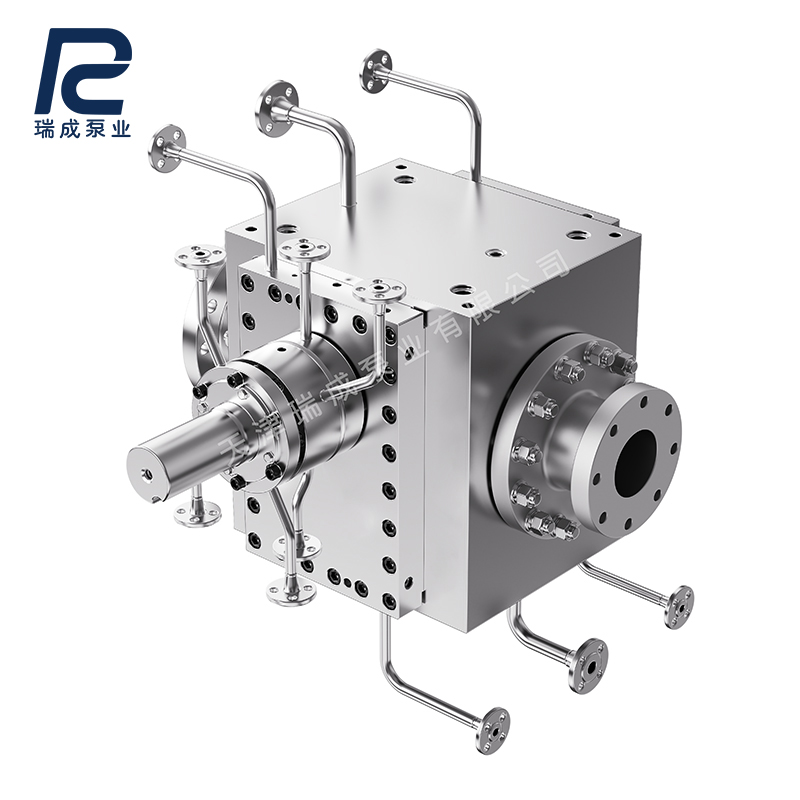
In plastic extrusion, polymer conveying, chemical fiber production, and high-viscosity melt pipeline conveying, melt pressure pumps are primarily used to stabilize pipeline pressure, improve the continuity of downstream material supply, and provide a relatively stable melt flow rate to downstream equipment such as filters, die heads, and metering systems. Whether a melt pump can operate stably depends not only on the pump’s own design but is also closely related to the adequacy of the upstream material supply. If the feed is insufficient, this is often quickly reflected in the equipment’s operating condition.
The first noticeable symptom is difficulty establishing outlet pressure or increased pressure fluctuations. Under normal conditions, melt line booster pumps rely on the positive displacement of gear cavities to continuously convey material, transporting the melt from the inlet to the outlet. If the melt supply at the inlet is insufficient, the gear cavities cannot be fully filled, resulting in a decrease in the pump’s effective delivery rate. This may cause the outlet pressure to fluctuate wildly or even fail to build up at all. For downstream die heads, filters, or pelletizing systems, these fluctuations can further compromise output stability.
Second, unstable flow rates are also a common symptom. When feed is insufficient, although the pump continues to rotate, the actual amount of melt conveyed per revolution is inadequate, resulting in fluctuating output volumes downstream. In sheet, film, pipe, fiber drawing, or pelletizing production lines, this may manifest as uneven product thickness, dimensional variations, inconsistent pellet size, or unstable fiber output. Many operators mistakenly attribute these issues to abnormalities in the die, haul-off, or pelletizing systems, when the actual cause may lie in insufficient feed at the front end.
Third, changes in the pump’s operating noise and vibration may occur. When the melt pump is fully loaded with material and operating at a stable pressure, its operating noise is typically steady. When inlet feed is insufficient, the gear meshing area may experience discontinuous material flow, localized dry running, or pressure surges. The equipment’s noise will become muffled, high-pitched, or accompanied by irregular fluctuations; in some operating conditions, slight vibration may also occur. Prolonged operation under these conditions increases the load on the gears, shaft sleeves, and seals.
Fourth, abnormalities may occur in motor current and speed feedback. Some production lines use variable-frequency control or closed-loop pressure control. When the system detects insufficient outlet pressure, it attempts to increase the speed to compensate for the pressure. However, if the inlet feed itself cannot keep up, it is difficult to achieve a stable flow rate even by increasing the speed; instead, this may place the pump in an even more unfavorable operating state. In such cases, phenomena such as increased speed without significant improvement in pressure, current fluctuations, and frequent adjustments by the control system may occur.
Fifth, material temperature and melt condition may also be affected. Insufficient feed is often related to unstable upstream temperatures, excessive pipeline resistance, filter blockages, excessively high melt viscosity, insufficient valve opening, or intermittent extruder feeding. When melt flow is inadequate, local residence times vary, which may result in inconsistent thermal history of the material; in severe cases, this can affect the surface quality of the finished product or material stability.
There are numerous causes of insufficient feed from the melt pipeline pressure-boosting pump. Common causes include insufficient output from the upstream extruder, excessive resistance in the pipeline or filters, improper inlet pipe diameter or connection method, material viscosity exceeding the design range, temperature settings that are too low, insufficient inlet pressure, and valves that are not fully open. Therefore, upon observing the aforementioned phenomena, it is not recommended to simply increase the pump speed blindly; instead, a comprehensive assessment should be made by considering the inlet pressure, outlet pressure, melt temperature, motor current, and the feed status of the upstream extruder.
For production lines with high continuity requirements, the selection and operation of melt line booster pumps should prioritize the following conditions: “sufficient upstream feed, full pump filling, and matched downstream pressure.” Only with a stable inlet feed can the melt pump fully perform its functions of pressure stabilization, pressure boosting, and metered delivery, thereby providing a more reliable process foundation for subsequent production.